
Clinical Research and Public HealthNephrologyOncology
Open Access |  10.1172/jci.insight.198098
Pan-cancer polygenic risk score associates with cancer susceptibility following kidney transplantation
Jarmo Ritari,1 Kati Hyvärinen,1 Kirsi Jahnukainen,2 FinnGen Consortium,3 Jukka Partanen,1 Ilkka Helanterä,4 and Timo Jahnukainen5
1Finnish Red Cross Blood Service, Helsinki, Finland.
2Division of Hematology-Oncology and Stem Cell Transplantation, New Children’s Hospital, Helsinki University Hospital and University of Helsinki, Helsinki, Finland.
3The FinnGen Consortium is detailed in Supplemental Acknowledgments.
4Transplantation and Liver Surgery, Helsinki University Hospital and University of Helsinki, Helsinki, Finland.
5Department of Pediatric Nephrology and Transplantation, New Children’s Hospital, Helsinki University Hospital and University of Helsinki, Helsinki, Finland.
Address correspondence to: Timo Jahnukainen, Department of Pediatric Nephrology and Transplantation, New Children’s Hospital, Helsinki University Hospital, Stenbäckinkatu 9, 00029 HUS, Finland. Email: timo.jahnukainen@hus.fi.
Find articles by Ritari, J. in: PubMed | Google Scholar
1Finnish Red Cross Blood Service, Helsinki, Finland.
2Division of Hematology-Oncology and Stem Cell Transplantation, New Children’s Hospital, Helsinki University Hospital and University of Helsinki, Helsinki, Finland.
3The FinnGen Consortium is detailed in Supplemental Acknowledgments.
4Transplantation and Liver Surgery, Helsinki University Hospital and University of Helsinki, Helsinki, Finland.
5Department of Pediatric Nephrology and Transplantation, New Children’s Hospital, Helsinki University Hospital and University of Helsinki, Helsinki, Finland.
Address correspondence to: Timo Jahnukainen, Department of Pediatric Nephrology and Transplantation, New Children’s Hospital, Helsinki University Hospital, Stenbäckinkatu 9, 00029 HUS, Finland. Email: timo.jahnukainen@hus.fi.
Find articles by Hyvärinen, K. in: PubMed | Google Scholar
1Finnish Red Cross Blood Service, Helsinki, Finland.
2Division of Hematology-Oncology and Stem Cell Transplantation, New Children’s Hospital, Helsinki University Hospital and University of Helsinki, Helsinki, Finland.
3The FinnGen Consortium is detailed in Supplemental Acknowledgments.
4Transplantation and Liver Surgery, Helsinki University Hospital and University of Helsinki, Helsinki, Finland.
5Department of Pediatric Nephrology and Transplantation, New Children’s Hospital, Helsinki University Hospital and University of Helsinki, Helsinki, Finland.
Address correspondence to: Timo Jahnukainen, Department of Pediatric Nephrology and Transplantation, New Children’s Hospital, Helsinki University Hospital, Stenbäckinkatu 9, 00029 HUS, Finland. Email: timo.jahnukainen@hus.fi.
Find articles by Jahnukainen, K. in: PubMed | Google Scholar
1Finnish Red Cross Blood Service, Helsinki, Finland.
2Division of Hematology-Oncology and Stem Cell Transplantation, New Children’s Hospital, Helsinki University Hospital and University of Helsinki, Helsinki, Finland.
3The FinnGen Consortium is detailed in Supplemental Acknowledgments.
4Transplantation and Liver Surgery, Helsinki University Hospital and University of Helsinki, Helsinki, Finland.
5Department of Pediatric Nephrology and Transplantation, New Children’s Hospital, Helsinki University Hospital and University of Helsinki, Helsinki, Finland.
Address correspondence to: Timo Jahnukainen, Department of Pediatric Nephrology and Transplantation, New Children’s Hospital, Helsinki University Hospital, Stenbäckinkatu 9, 00029 HUS, Finland. Email: timo.jahnukainen@hus.fi.
1Finnish Red Cross Blood Service, Helsinki, Finland.
2Division of Hematology-Oncology and Stem Cell Transplantation, New Children’s Hospital, Helsinki University Hospital and University of Helsinki, Helsinki, Finland.
3The FinnGen Consortium is detailed in Supplemental Acknowledgments.
4Transplantation and Liver Surgery, Helsinki University Hospital and University of Helsinki, Helsinki, Finland.
5Department of Pediatric Nephrology and Transplantation, New Children’s Hospital, Helsinki University Hospital and University of Helsinki, Helsinki, Finland.
Address correspondence to: Timo Jahnukainen, Department of Pediatric Nephrology and Transplantation, New Children’s Hospital, Helsinki University Hospital, Stenbäckinkatu 9, 00029 HUS, Finland. Email: timo.jahnukainen@hus.fi.
Find articles by Partanen, J. in: PubMed | Google Scholar
1Finnish Red Cross Blood Service, Helsinki, Finland.
2Division of Hematology-Oncology and Stem Cell Transplantation, New Children’s Hospital, Helsinki University Hospital and University of Helsinki, Helsinki, Finland.
3The FinnGen Consortium is detailed in Supplemental Acknowledgments.
4Transplantation and Liver Surgery, Helsinki University Hospital and University of Helsinki, Helsinki, Finland.
5Department of Pediatric Nephrology and Transplantation, New Children’s Hospital, Helsinki University Hospital and University of Helsinki, Helsinki, Finland.
Address correspondence to: Timo Jahnukainen, Department of Pediatric Nephrology and Transplantation, New Children’s Hospital, Helsinki University Hospital, Stenbäckinkatu 9, 00029 HUS, Finland. Email: timo.jahnukainen@hus.fi.
Find articles by Helanterä, I. in: PubMed | Google Scholar
1Finnish Red Cross Blood Service, Helsinki, Finland.
2Division of Hematology-Oncology and Stem Cell Transplantation, New Children’s Hospital, Helsinki University Hospital and University of Helsinki, Helsinki, Finland.
3The FinnGen Consortium is detailed in Supplemental Acknowledgments.
4Transplantation and Liver Surgery, Helsinki University Hospital and University of Helsinki, Helsinki, Finland.
5Department of Pediatric Nephrology and Transplantation, New Children’s Hospital, Helsinki University Hospital and University of Helsinki, Helsinki, Finland.
Address correspondence to: Timo Jahnukainen, Department of Pediatric Nephrology and Transplantation, New Children’s Hospital, Helsinki University Hospital, Stenbäckinkatu 9, 00029 HUS, Finland. Email: timo.jahnukainen@hus.fi.
Find articles by Jahnukainen, T. in: PubMed | Google Scholar
Published April 23, 2026 - More info
JCI Insight. 2026;11(11):e198098. https://doi.org/10.1172/jci.insight.198098.
© 2026 Ritari et al. This work is licensed under the Creative Commons Attribution 4.0 International License. To view a copy of this license, visit http://creativecommons.org/licenses/by/4.0/.
Received: August 5, 2025; Accepted: April 10, 2026

-
Introduction
Solid organ transplantation (SOT) is the treatment of choice for severe kidney, liver, and heart failure, with substantially improved short- and long-term outcomes (1–3). Lifelong immunosuppression is essential to prevent allograft rejection. In pediatric and young adult patients, exposure to immunomodulatory drugs may span several decades (4, 5). Consequently, SOT recipients face increased risks of posttransplant complications, including diabetes, osteoporosis, cardiovascular disease, fertility problems, and malignancies (6–9).
Cancer is among the most serious long-term complications after SOT, accounting for over 20% of late posttransplant deaths (10–18). Large population-based studies show that transplant recipients without preexisting cancer have approximately double the risk of malignancy compared with the general population (10–15). Notably, Webster et al. reported that kidney transplant (KT) recipients are diagnosed with cancer earlier than non-transplanted patients (19). This elevated risk is largely attributed to prolonged immunosuppression (10, 20), which impairs immune surveillance and increases susceptibility to infection-associated cancers such as non-Hodgkin lymphoma, liver cancer, and Kaposi’s sarcoma. Risks of non–infection-related cancers, including kidney and thyroid cancer, are also elevated. Moreover, immunosuppressive agents like calcineurin inhibitors and azathioprine may promote carcinogenesis via non-immune mechanisms (10).
The contribution of genetic factors to posttransplant cancer risk remains unclear. Some evidence links genetic polymorphisms, especially those affecting skin type, to elevated skin cancer risk in SOT recipients. Specific variants in IL-10 and TGF-β genes have been associated with posttransplant lymphoproliferative disorder (21, 22). Stapleton et al. demonstrated (23) that a polygenic risk score (PRS) for non-melanoma skin cancer (NMSC) can predict both risk and timing of NMSC after transplantation. Another study showed (24) that PRSs can stratify SOT recipients into high- and low-risk groups for basal cell carcinoma (BCC) and squamous cell carcinoma (SCC). PRSs have also been applied to posttransplant kidney function (25) and diabetes (26). However, large-scale studies on genetic cancer risk in transplant recipients remain lacking.
In this study, we evaluated genetic risk factors for posttransplant cancer using data from the FinnGen cohort (27), which includes genetic and health registry data from approximately 500,000 Finnish non-transplantation biobank participants and 2,000 SOT patients. To assess how common germline variants influence timing of first cancer diagnosis, we developed a pan-cancer PRS encompassing multiple cancer types (Figure 1). We validated the PRS in the non-transplantation FinnGen population and applied it to KT recipients to compare individuals with and without posttransplant malignancies. We hypothesized that KT recipients developing cancer at a young age would exhibit a higher genetic risk, as measured by the PRS, than those who remain cancer-free.
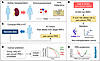 Figure 1
Schematic overview of the study. (A) Kidney transplantation (KT) patients receive long-term immunosuppression, which elevates post-KT cancer risk especially in young patients. (B) A pan-cancer polygenic risk score (PRS) is constructed by selecting statistically significant variants from an UK Biobank (UKB) and US Kaiser Permanente (GERA) GWAS meta-analysis (28) and extracting the risk alleles of the selected variants from FinnGen non-transplantation population (n = 496,641). The PRS is a sum of the number of risk variants normalized for cancer type. The pan-cancer PRS is then validated against longitudinal electronic health record data of cancer diagnoses by fitting a multivariate Cox proportional hazards (coxph) survival model for time to first cancer occurrence in FinnGen non-transplantation cohort. (C) The pan-cancer PRS target variants are extracted from the FinnGen KT cohort and the PRS is similarly computed for the KT patients. (D) The PRS in the KT cohort is combined with longitudinal cancer diagnosis data to fit coxph models. The ability of the PRS to stratify KT patients into low- and high-risk groups is evaluated. (E) The effect of the PRS on plasma protein expression levels is measured in the UK Biobank.
-
Results
Patient characteristics and data coverage. The FinnGen non-transplantation dataset included 496,641 individuals, while the KT dataset comprised 1,546 patients. Liver and lung transplantation (LLT) patients numbered 476. Among the non-transplantation cohort, 115,917 individuals had a cancer diagnosis, and 317 KT patients and 99 LLT patients were diagnosed with cancer after transplantation. Bone mass index (BMI) and smoking data were available for 279,283 non-transplantation individuals and 688 KT patients.
Of the 10,626 quality-filtered genetic variants used to construct the pan-cancer PRS, 9,818 (92.3%) were present in the FinnGen genotype data. Variant counts per cancer type are listed in Supplemental Table 1; supplemental material available online with this article; https://doi.org/10.1172/jci.insight.198098DS1
Table 1 summarizes key demographic and clinical characteristics of KT recipients with and without posttransplant cancer, including age, follow-up time, and primary renal diagnosis. KT recipients with posttransplant cancer were significantly older at transplantation than those without cancer. Median follow-up time did not differ significantly. Glomerulonephritis and polycystic kidney disease (PKD) (Supplemental Table 2) were more common primary renal diagnoses among patients with cancer, while diabetic nephropathy tended to be more common in those without; however, the difference did not reach statistical significance (Table 1). Diabetes as a comorbidity also differed statistically significantly between groups. Distribution of primary diagnoses over time in the KT cohort is shown by Supplemental Figure 1. The most common cancer diagnosis class (Supplemental Table 3) among KT patients was BCC (Supplemental Figure 2). LTT patients’ demographic information is summarized by Supplemental Table 4.
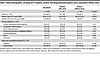 Table 1
Patient demographics, including all KT recipients, patients with diagnosed posttransplant cancer, and patients without cancer
PRS validation and cancer risk in the KT population. Evaluation of cancer-type-specific PRSs and 4 different pan-cancer allele scoring methods in the FinnGen non-transplantation cohort indicated that the sum of allele dosages yielded the best hazard ratio (HR) and P value (Figure 2A). Based on these findings, the allele dosage sum was selected as the preferred method for constructing the pan-cancer PRS. This PRS followed a normal distribution in the non-transplantation cohort (Figure 2B), allowing for stratification into low- and high-risk groups based on standard deviation (SD) thresholds. HRs for overall cancer risk, calculated using the Cox model, showed that PRS values further from the mean were associated with increasingly extreme HRs (Figure 2C), indicating a stronger association with cancer risk. Cox proportional hazards (coxph) analysis of the full dataset that included both the non-transplantation cohort and the KT cohort did not show evidence of interaction between transplantation status and the PRS (HR 1.47, 95% CI 0.6–3.5, P = 0.358) (Supplemental Table 5).
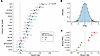 Figure 2
Validation of the pan-cancer polygenic risk score (PRS) in non-transplantation FinnGen cohort. (A) Hazard ratios for overall cancer risk of the various cancer-type-specific risk scores and the 4 pan-cancer PRS candidates (sum, max, min, and pos; see Methods for details) obtained from multivariate Cox proportional hazards (coxph) survival models. The coxph models analyze the time to the first cancer diagnosis with and without adjusting for BMI and smoking along with other model covariates such as sampling age and population stratification (see Methods). (B) Continuous population distribution of the best performing score (“sum”) that is used as the pan-cancer PRS of choice in the follow-up analyses. The x-axis unit is the standard deviation of the mean (SD). The distribution tails, which are colored according to protective (green) and risk (red) PRS directions, are most relevant for cancer risk analysis and stratification. (C) PRS distribution in the FinnGen non-transplantation cohort categorized into 2 classes according to SD (binary PRS) and analyzed with coxph survival models. The distribution tails behave as expected by increasing or lowering the risk according to the distanced from the PRS mean. In A and C, the error bars represent 95% CIs. Survival analyses in A were performed with multivariable coxph regression.
To assess the PRS’s ability to predict cancer severity in the non-transplantation group, we classified ICD-O-3 cancer behavior into benign/semimalignant versus malignant categories. A Cox model adjusting for sampling year, age at sampling, principal components 1–10, smoking status, BMI, sex, diabetes, and family history of malignancy showed a significant positive association between the pan-cancer PRS and malignant cancer (P < 0.001).
In analyzing the KT and LTT cohorts, we focused on patients younger than 40 years at the time of transplantation. We hypothesized that the higher cancer prevalence in the transplant population may partly reflect prolonged immunosuppression, which could allow underlying genetic predisposition to manifest as cancer at a younger age. This age threshold is consistent with the NIH and American Cancer Society (ACS) definition of young cancer patients (<40 years; https://www.cancer.gov/types/aya). We divided the young KT patients into the high- and low-risk groups, as defined by the pan-cancer PRS ±1 SD, and analyzed their differences in terms of cancer types and number of unique cancer diagnoses. The high-risk group had more diagnoses of lymphoma and BCC compared with the low-risk group (Figure 3A), as well as a higher total number of cancer diagnoses overall (Figure 3B). However, breast cancer diagnoses were less frequent in the high-PRS group than in the low-risk group.
 Figure 3
Cancer diagnoses in the high and low pan-cancer PRS groups under 40 years of age at KT. (A) Difference in numbers of cancer diagnoses between the high (+1 SD) and low (–1 SD) PRS groups. (B) Cumulative sum of unique cancer diagnoses over the follow-up period after KT. A given cancer type can be represented by multiple diagnosis entries. The lines represent averages over 100 sample order randomizations (see Methods).
Model covariates. Analysis of the FinnGen non-transplantation cohort with coxph included age at sampling, sampling year, sex, biobank cohort, the first 10 genetic principal components, family history of malign neoplasm, and diabetes diagnosis as the basic set of analysis covariates. Race and ethnicity were not available in the FinnGen dataset and were therefore not included as variables in the analysis. BMI and smoking information were added for an additional analysis because these data were not available for all individuals (Figure 1). Family history of malignant neoplasm, representing rare high-risk germline variants, was significantly associated with increased cancer risk (P < 0.001) (Supplemental Figure 3), independently of the PRS.
Coxph analysis covariates for KT and LLT cohorts included sampling year, age at sampling, age at transplantation, sex, the first 10 genetic principal components, family history of malign neoplasm, and diabetes diagnosis. The KT cohort was also analyzed by including BMI and smoking as covariates, although this reduced the number of available samples (Supplemental Table 6). The most significant predictor was patient age at the time of transplantation (P < 0.001) (Supplemental Table 6).
PRS and time between KT and cancer occurrence. We next compared cancer occurrence between the FinnGen non-transplantation cohort and the KT cohort among individuals sampled before age 40 (the age limit of a young cancer patient according to NIH and ACS) and adjusted for age, sex, smoking, BMI, and the first 10 genetic principal components. The result showed that cancer occurred earlier in KT patients than in non-KT individuals (Figure 4A). Similarly, patient age at the time of transplantation influenced the timing of first cancer occurrence during follow-up (Figure 4B).
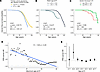 Figure 4
Cancer risk in KT recipients. (A) Kaplan-Meier survival curves for the time to the first cancer diagnosis in KT cohort versus non-transplantation cohort in FinnGen, limited to individuals sampled below 40 years of age. The P value was obtained from the coxph model (see Methods) adjusted for age, sex, population stratification, genetic cancer risk, BMI, and smoking. (B) Kaplan-Meier curves for the time to the first cancer diagnosis by binned patient age at KT. The P value was obtained from a coxph model as described above. (C) Kaplan-Meier curves for the time to the first cancer diagnosis in KT recipients under 40 years of age at the time of KT, stratified for high (+1 SD) and low (–1 SD) pan-cancer PRS. The P value was obtained from a coxph model for continuous PRS as described above, including transplantation age as a covariate, but excluding BMI and smoking. (D) Pan-cancer PRS coxph model hazard ratio for the first cancer diagnosis as a function of cumulative maximum age at KT, ranging from 18 to 80 years of age at KT. The models are adjusted as described above, including age at KT, but excluding BMI and smoking. (E) Pan-cancer PRS hazard ratios by KT age bins of 10 years, showing higher risk in young patients. The first bin was defined by the youngest age at KT for which the cox model could be fitted without errors. Survival analyses in A–C were performed with multivariable coxph regression. Analysis of trend in D was performed with univariate linear regression.
When stratifying KT recipients under 40 years of age at KT into high- and low-risk groups based on their pan-cancer PRS values, individuals in the high-risk group (+1 SD) experienced earlier first cancer events compared with those in the low-risk group (–1 SD) (Figure 4C). Further analysis of PRS HRs across cumulative transplantation age showed that HRs were generally higher in younger patients (Figure 4, D and E), highlighting a stronger genetic contribution to cancer risk in pediatric and young adult KT recipients. Coxph results from different age limits at transplantation for KT patients are shown in Supplemental Table 7.
PRS in lung and liver transplantation patients. We conducted a replication analysis of the PRS effect observed in young KT patients by applying the same PRS to LLT SOT recipients in FinnGen. In contrast to the KT cohort, the PRS was not statistically significant among LLT patients younger than 40 years at the time of transplantation (n = 108) when using the same covariates and including transplantation type in the coxph model. We additionally tested the interaction between the PRS and diabetes diagnosis within the same model and found that the interaction term was associated with a statistically significant increase in risk (HR 3.99, 95% CI 1.38–11.6, P = 0.0106) (Supplemental Figure 4).
Adjustment for multiple testing. After testing multiple PRS candidates in the non-transplantation cohort, assessing PRS and family history of malignancy across age groups in the KT cohort, and evaluating the PRS in the LTT cohort, and other tests, we compiled the resulting P values for multiple-hypothesis correction, which forms the basis of our conclusions. The Benjamini-Yekutieli–adjusted P values are presented in Supplemental Table 8. The corrected P value for the PRS in KT recipients younger than 40 years at the time of transplantation was 0.23.
Plasma proteome quantitative traits in the UK Biobank. To elucidate the functional basis of the PRS, we examined its association with plasma protein expression levels in the UK Biobank cohort (n = 53,013). This analysis identified 87 proteins whose levels were significantly regulated by the PRS after Bonferroni correction (adjusted P < 0.05; Figure 5). Of these, 61 proteins were upregulated and 26 were downregulated. We then performed functional enrichment analyses separately for the upregulated and downregulated sets (Supplemental Figure 5). Upregulated proteins were predominantly enriched for cell surface components (FDR < 0.05), whereas the downregulated proteins were enriched for lysosomal hydrolases and proteases.
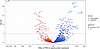 Figure 5
Regulation of plasma protein levels by the pan-cancer PRS in the UK Biobank. The x-axis displays the effect size of the PRS on plasma protein levels, and the y-axis shows the corresponding association P values. The horizontal dashed line marks the Bonferroni-corrected significance threshold (P < 1.71 × 10⁻⁵). Analysis of expression levels was performed with multivariable logistic regression.


