
Abstract
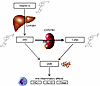
BACKGROUND Active vitamin D metabolites, including 25-hydroxyvitamin D (25D) and 1,25-dihydroxyvitamin D (1,25D), have potent immunomodulatory effects that attenuate acute kidney injury (AKI) in animal models.METHODS We conducted a phase 2, randomized, double-blind, multiple-dose, 3-arm clinical trial comparing oral calcifediol (25D), calcitriol (1,25D), and placebo among 150 critically ill adult patients at high risk of moderate to severe acute kidney injury (AKI). The primary endpoint was a hierarchical composite of death, kidney replacement therapy (KRT), and kidney injury (baseline-adjusted mean change in serum creatinine), each assessed within 7 days following enrollment using a rank-based procedure. Secondary endpoints included new or progressive AKI and a composite of KRT or death. Hypercalcemia was the key safety endpoint. We also performed RNA-Seq on circulating CD14+ monocytes collected immediately prior to randomization and 2 days later.RESULTS The global rank score for the primary endpoint was similar among calcifediol- (n = 51) versus placebo- (n = 49) treated patients (P = 0.85) and for calcitriol (n = 50) versus placebo-treated patients (P = 0.58). Secondary endpoints also occurred at similar rates across groups. Hypercalcemia occurred in 1 patient in the calcifediol group (1.7%), 1 patient in the calcitriol group (2.0%), and no patients in the placebo group. Compared with placebo, calcitriol upregulated more individual genes and pathways in circulating monocytes than did calcifediol, including pathways involving IFN-α, IFN-γ, oxidative phosphorylation, DNA repair, and heme metabolism.CONCLUSION Treatment with calcifediol or calcitriol in critically ill adults upregulated multiple genes and pathways involving immunomodulation, DNA repair, and heme metabolism, but it did not attenuate AKI.TRIAL REGISTRATION ClinicalTrials.gov (NCT02962102)FUNDING NIH/NIDDK grant K23DK106448 (to DEL) and NIH/NHLBI grant R01HL16687 (to EYK).
Authors
David E. Leaf, Tushar Shenoy, Kevin Zinchuk, Shruti Gupta, Julie-Alexia Dias, Daniel Sanchez-Almanzar, Adit A. Ginde, Humra Athar, Changde Cheng, Tomoyoshi Tamura, Edy Y. Kim, Sushrut S. Waikar
This file is in Adobe Acrobat (PDF) format. If you have not installed and configured the Adobe Acrobat Reader on your system.
Having trouble reading a PDF?
PDFs are designed to be printed out and read, but if you prefer to read them online, you may find it easier if you increase the view size to 125%.
Having trouble saving a PDF?
Many versions of the free Acrobat Reader do not allow Save. You must instead save the PDF from the JCI Online page you downloaded it from. PC users: Right-click on the Download link and choose the option that says something like "Save Link As...". Mac users should hold the mouse button down on the link to get these same options.
Having trouble printing a PDF?
- Try printing one page at a time or to a newer printer.
- Try saving the file to disk before printing rather than opening it "on the fly." This requires that you configure your browser to "Save" rather than "Launch Application" for the file type "application/pdf", and can usually be done in the "Helper Applications" options.
- Make sure you are using the latest version of Adobe's Acrobat Reader.


