
Submit a comment
Abstract
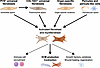
As the principal ECM-producing cell type, fibroblasts are essential regulators of tissue architecture and function in development, homeostasis, and disease. While their disease-promoting functions in fibrosis have long been the center of attention, it is increasingly recognized that fibroblasts exert critical homeostatic roles across organs, acting as sentinels that regulate the function, proliferation, and recruitment of epithelial, endothelial and immune cells in health and disease. Here, we will review the roles of fibroblasts and fibroblast-like cells in tissue maintenance, physiological wound healing, regeneration, maladaptive fibrosis, and cancer across major organs, including the skin, lung, liver, intestine, and kidney, and highlight organ-specific and shared populations and functions. We will discuss the role of PI16+ and COL15A1+ universal fibroblasts, organ-specific fibroblasts, and pericyte and pericyte-like stellate cells as cellular sources for the majority of CTHRC1+ activated fibroblasts and αSMA+ or LRRC15+ myofibroblasts and highlight the functions of specialized subpopulations, such as inflammatory fibroblasts, antigen-presenting fibroblasts, and fibroblast-like cells, including mesothelial and smooth muscle cells. A refined understanding of fibroblast heterogeneity holds promise for novel therapeutic concepts, aimed at targeting pathogenic subpopulations while preserving or enhancing homeostatic functions.
Authors
Xiaochun Yang, Marcella Steffani, Sandeep Nadella, Dean Sheppard, Florian Rieder, Yuval Rinkevich, Rafael Kramann, David A. Tuveson, Robert F. Schwabe
Guidelines
The Editorial Board will only consider comments that are deemed relevant and of interest to readers. The Journal will not post data that have not been subjected to peer review; or a comment that is essentially a reiteration of another comment.
- Comments appear on the Journal’s website and are linked from the original article’s web page.
- Authors are notified by email if their comments are posted.
- The Journal reserves the right to edit comments for length and clarity.
- No appeals will be considered.
- Comments are not indexed in PubMed.
Specific requirements
- Maximum length, 400 words
- Entered as plain text or HTML
- Author’s name and email address, to be posted with the comment
- Declaration of all potential conflicts of interest (even if these are not ultimately posted); see the Journal’s conflict-of-interest policy
- Comments may not include figures


