
Submit a comment
Abstract
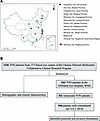
BACKGROUND Traumatic optic neuropathy (TON) is a leading cause of blindness following closed traumatic brain injury, with no effective treatments available. Previous interventional clinical trials were complicated by its low prevalence, variability in neurodegenerative severity, and unavailability of reliable biomarkers.METHODS We analyzed data from 1,226 patients enrolled in the prospective National Multi-Center Collaborative Clinical Research Program of China (2017–2024) to establish a clinical profile and identify noninvasive biomarkers for neurodegenerative severity. Subgroup analysis of patients with monocular TON revealed potential biomarkers, including visual functional parameters, inner retinal thickness, and time postinjury.RESULTS The ganglion cell complex (GCC) thickness showed a strong correlation with retinal ganglion cell somata (R² = 0.87, P < 0.0001) and axon density (R² = 0.89, P < 0.0001) in a clinically relevant large animal model. Computational analysis demonstrated that using GCC thickness as a biomarker could substantially enhance the statistical power of clinical trials (by up to 4.5-fold), as verified by real-world data.CONCLUSION This study presents the largest epidemiological analysis of TON to date and establishes GCC thickness as a crucial biomarker for stratifying disease severity and improving the efficiency of clinical trials.TRIAL REGISTRATION Chinese Clinical Trial Registry (ChiCTR-OOC-17013437).FUNDING National Key R&D Program of China (Grant No. 2022YFA1105500), Key Science and Technology Program of Wenzhou (Grant No. ZY2022021), National Natural Science Foundation of China (Grant No. 82471080).
Authors
YiKui Zhang, BoYue Xu, ShiWei Huang, ZhaoHui Shi, Wei Xiong, Ruijun Wang, GuiQin Liu, Linlin Chen, ZhenHua Ge, YongJie Zhang, HongLei Liu, BaoYun Jia, ChunXia Wang, HaiHong Shi, Jun Kang, NingYu An, ShuRui Huang, DeFu Chen, ShengHai Huang, YuTing Luo, MingYue Liu, ZhuoWei Wang, ZhongHao Yu, Jingwei Zheng, Wentao Yan, Gen Li, Hao Chen, XingGuang Deng, ShiHui Wei, YunHai Tu, EnDe Wu, Kang Zhang, WenCan Wu
Guidelines
The Editorial Board will only consider comments that are deemed relevant and of interest to readers. The Journal will not post data that have not been subjected to peer review; or a comment that is essentially a reiteration of another comment.
- Comments appear on the Journal’s website and are linked from the original article’s web page.
- Authors are notified by email if their comments are posted.
- The Journal reserves the right to edit comments for length and clarity.
- No appeals will be considered.
- Comments are not indexed in PubMed.
Specific requirements
- Maximum length, 400 words
- Entered as plain text or HTML
- Author’s name and email address, to be posted with the comment
- Declaration of all potential conflicts of interest (even if these are not ultimately posted); see the Journal’s conflict-of-interest policy
- Comments may not include figures


