
Go to The Journal of Clinical Investigation
  • About
  • Editors
  • Consulting Editors
  • For authors
  • Publication ethics
  • Publication alerts by email
  • Transfers
  • Advertising
  • Job board
  • Contact
  • Physician-Scientist Development
  • Current issue
  • Past issues
  • By specialty
    • COVID-19
    • Cardiology
    • Immunology
    • Metabolism
    • Nephrology
    • Oncology
    • Pulmonology
    • All ...
  • Videos
  • Collections
    • In-Press Preview
    • Resource and Technical Advances
    • Clinical Research and Public Health
    • Research Letters
    • Editorials
    • Perspectives
    • Physician-Scientist Development
    • Reviews
    • Top read articles

  • Current issue
  • Past issues
  • Specialties
  • In-Press Preview
  • Resource and Technical Advances
  • Clinical Research and Public Health
  • Research Letters
  • Editorials
  • Perspectives
  • Physician-Scientist Development
  • Reviews
  • Top read articles
  • About
  • Editors
  • Consulting Editors
  • For authors
  • Publication ethics
  • Publication alerts by email
  • Transfers
  • Advertising
  • Job board
  • Contact

Citations to this article
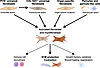
Fibroblasts: a diverse population of cells balancing homeostasis, wound healing, regeneration, inflammation, fibrosis, and cancer across organs
Xiaochun Yang, Marcella Steffani, Sandeep Nadella, Dean Sheppard, Florian Rieder, Yuval Rinkevich, Rafael Kramann, David A. Tuveson, Robert F. Schwabe
View: Text | PDF
Review

Fibroblasts: a diverse population of cells balancing homeostasis, wound healing, regeneration, inflammation, fibrosis, and cancer across organs

  • Text
  • PDF
Abstract

As the principal ECM-producing cell type, fibroblasts are essential regulators of tissue architecture and function in development, homeostasis, and disease. While their disease-promoting functions in fibrosis have long been the center of attention, it is increasingly recognized that fibroblasts exert critical homeostatic roles across organs, acting as sentinels that regulate the function, proliferation, and recruitment of epithelial, endothelial and immune cells in health and disease. Here, we will review the roles of fibroblasts and fibroblast-like cells in tissue maintenance, physiological wound healing, regeneration, maladaptive fibrosis, and cancer across major organs, including the skin, lung, liver, intestine, and kidney, and highlight organ-specific and shared populations and functions. We will discuss the role of PI16+ and COL15A1+ universal fibroblasts, organ-specific fibroblasts, and pericyte and pericyte-like stellate cells as cellular sources for the majority of CTHRC1+ activated fibroblasts and αSMA+ or LRRC15+ myofibroblasts and highlight the functions of specialized subpopulations, such as inflammatory fibroblasts, antigen-presenting fibroblasts, and fibroblast-like cells, including mesothelial and smooth muscle cells. A refined understanding of fibroblast heterogeneity holds promise for novel therapeutic concepts, aimed at targeting pathogenic subpopulations while preserving or enhancing homeostatic functions.

Authors

Xiaochun Yang, Marcella Steffani, Sandeep Nadella, Dean Sheppard, Florian Rieder, Yuval Rinkevich, Rafael Kramann, David A. Tuveson, Robert F. Schwabe

×

Loading citation information...
Advertisement

Copyright © 2026 American Society for Clinical Investigation
ISSN 2379-3708

Sign up for email alerts