
Go to The Journal of Clinical Investigation
  • About
  • Editors
  • Consulting Editors
  • For authors
  • Publication ethics
  • Publication alerts by email
  • Transfers
  • Advertising
  • Job board
  • Contact
  • Physician-Scientist Development
  • Current issue
  • Past issues
  • By specialty
    • COVID-19
    • Cardiology
    • Immunology
    • Metabolism
    • Nephrology
    • Oncology
    • Pulmonology
    • All ...
  • Videos
  • Collections
    • In-Press Preview
    • Resource and Technical Advances
    • Clinical Research and Public Health
    • Research Letters
    • Editorials
    • Perspectives
    • Physician-Scientist Development
    • Reviews
    • Top read articles

  • Current issue
  • Past issues
  • Specialties
  • In-Press Preview
  • Resource and Technical Advances
  • Clinical Research and Public Health
  • Research Letters
  • Editorials
  • Perspectives
  • Physician-Scientist Development
  • Reviews
  • Top read articles
  • About
  • Editors
  • Consulting Editors
  • For authors
  • Publication ethics
  • Publication alerts by email
  • Transfers
  • Advertising
  • Job board
  • Contact
The role of complement in long COVID pathogenesis
Rafael Bayarri-Olmos, William Bain, Akiko Iwasaki
View: Text | PDF
Review

The role of complement in long COVID pathogenesis

  • Text
  • PDF
Abstract

Long COVID is a debilitating condition that can develop after a SARS-CoV-2 infection and is characterized by a wide range of chronic symptoms, including weakness, neurocognitive impairment, malaise, fatigue, and many others, that affect multiple organ systems. At least 10% of individuals with a previous infection may develop long COVID, which affects their ability to perform daily functions and work. Despite its severity and widespread impact, this multisystemic condition remains poorly understood. Recent studies suggest that dysregulation of the complement system, a key component of the innate immune response, may contribute to the pathogenesis of long COVID, particularly in connection with coagulation, inflammation, and vascular injury. In this Review, we examine the evidence linking complement system dysregulation to long COVID and explore its potential role in driving disease pathology.

Authors

Rafael Bayarri-Olmos, William Bain, Akiko Iwasaki

×

Figure 2

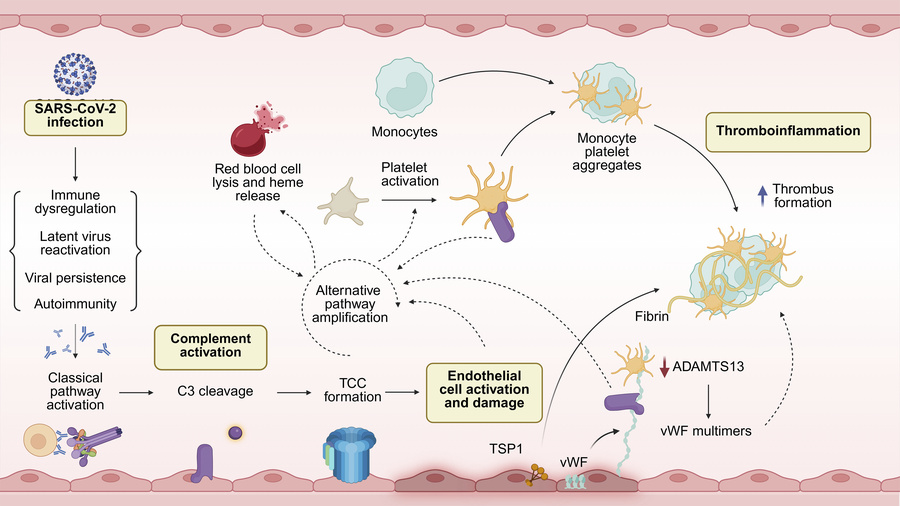
Proposed drivers of complement activation in long COVID.
Options: View larger image (or click on image) Download as PowerPoint
Proposed drivers of complement activation in long COVID.
SARS-CoV-2 infe...
SARS-CoV-2 infection triggers activation of the complement cascade through direct interaction with viral components or virus-specific antibodies, typically resolving once the infection is cleared. However, in patients with long COVID, this activation may persist, potentially contributing to ongoing symptoms. Several proposed mechanisms of long COVID can directly activate the complement system. For example, antiherpesvirus antibodies, likely the result of herpesvirus reactivation, or autoantibodies may drive activation via the classical pathway. Insertion of TCC in the endothelial cell wall causes activation and cell damage, causing the release of TSP1 and vWF. TSP1 promotes formation of monocyte-platelet aggregates, while vWF release — coupled with reduced levels of ADAMTS13, the metalloproteinase responsible for processing vWF multimers — leads to the accumulation of large or ultralarge vWF multimers on the endothelial surface. This, in turn, promotes platelet recruitment and thrombus formation. Additionally, vWF multimers on the endothelium, along with properdin and P selectin on activated platelets, can trap C3b, fueling complement activation via the amplification loop of the alternative pathway. Uncontrolled complement activation in the vasculature leads to red blood cell lysis, causing the release of heme and activation of the alternative pathway. Finally, tissue damage resulting from acute COVID-19, autoimmunity, or viral antigen reservoirs may all contribute to the persistent complement activation observed in patients with long COVID.

Copyright © 2025 American Society for Clinical Investigation
ISSN 2379-3708

Sign up for email alerts