
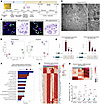
Abstract
Kidney organoids are an emerging tool for disease modeling, especially genetic diseases. Among these diseases, X-linked Alport syndrome (XLAS) is a hematuric nephropathy affecting the glomerular basement membrane (GBM) secondary to pathogenic variations in the COL4A5 gene encoding the α5 subunit of type IV collagen [α5(IV)]. In patients carrying pathogenic variations affecting splicing, the use of antisense oligonucleotides (ASOs) offers immense therapeutic hope. In this study, we develop a framework combining the use of patient-derived cells and kidney organoids to provide evidence of the therapeutic efficacy of ASOs in XLAS patients. Using multiomics analysis, we describe the development of GBM in WT and mutated human kidney organoids. We show that GBM maturation is a dynamic process, which requires long organoid culture. Then, using semi-automated quantification of α5(IV) at basement membranes in organoids carrying the splicing variants identified in patients, we demonstrate the efficacy of ASO treatment for α5(IV) restoration. These data contribute to our understanding of the development of GBM in kidney organoids and pave the way for a therapeutic screening platform for patients.
Authors
Hassan Saei, Bruno Estebe, Nicolas Goudin, Mahsa Esmailpour, Julie Haure, Olivier Gribouval, Christelle Arrondel, Vincent Moriniere, Pinyuan Tian, Rachel Lennon, Corinne Antignac, Geraldine Mollet, Guillaume Dorval
This file is in Adobe Acrobat (PDF) format. If you have not installed and configured the Adobe Acrobat Reader on your system.
Having trouble reading a PDF?
PDFs are designed to be printed out and read, but if you prefer to read them online, you may find it easier if you increase the view size to 125%.
Having trouble saving a PDF?
Many versions of the free Acrobat Reader do not allow Save. You must instead save the PDF from the JCI Online page you downloaded it from. PC users: Right-click on the Download link and choose the option that says something like "Save Link As...". Mac users should hold the mouse button down on the link to get these same options.
Having trouble printing a PDF?
- Try printing one page at a time or to a newer printer.
- Try saving the file to disk before printing rather than opening it "on the fly." This requires that you configure your browser to "Save" rather than "Launch Application" for the file type "application/pdf", and can usually be done in the "Helper Applications" options.
- Make sure you are using the latest version of Adobe's Acrobat Reader.


