
Abstract
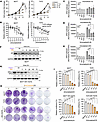
Estrogen receptor α (ER) is a critical driver of tumorigenesis and tumor progression in most breast cancers. Endocrine therapies (ET) targeting ER are central to treating hormone receptor–positive breast cancer, but resistance poses a clinical challenge. Some resistance mechanisms, particularly those involving estrogen-independent activity such as the ESR1 mutations, rely on ER signaling, supporting the need for next-generation ET. We investigated the preclinical efficacy of imlunestrant, an oral selective ER degrader, in ER-positive breast cancer preclinical models, including models harboring the Y537S ESR1 mutation, an activating mutation. Imlunestrant demonstrated antagonistic activity and effective degradation of both WT and mutant ER, resulting in cell growth suppression. In vivo, imlunestrant outperformed fulvestrant, leading to tumor regression in a patient-derived xenograft harboring the Y537S ESR1 mutation. Cyclic mutiplexed immunofluorescence and transcriptomic analysis revealed enhanced cell cycle arrest and downregulation of estrogen-responsive genes with imlunestrant treatment. Additionally, a genome-wide CRISPR knock–out screen identified several vulnerabilities that were either persistent or acquired after imlunestrant treatment, providing a rationale for future studies of combination treatments with imlunestrant. Collectively, these results highlight the on-target and selective activity of imlunestrant, which can circumvent resistance engendered by the Y537S ESR1 mutation.
Authors
Shira Sherman, Zachary M. Sandusky, Douglas Russo, David Zak, Agostina Nardone, Delia Friel, Francisco Hermida-Prado, Capucine Heraud, Genevra Kuziel, Ana Verma, Giorgio Gaglia, Sheheryar Kabraji, Quang-De Nguyen, Sandro Santagata, Sean W. Fanning, Rinath Jeselsohn
This file is in Adobe Acrobat (PDF) format. If you have not installed and configured the Adobe Acrobat Reader on your system.
Having trouble reading a PDF?
PDFs are designed to be printed out and read, but if you prefer to read them online, you may find it easier if you increase the view size to 125%.
Having trouble saving a PDF?
Many versions of the free Acrobat Reader do not allow Save. You must instead save the PDF from the JCI Online page you downloaded it from. PC users: Right-click on the Download link and choose the option that says something like "Save Link As...". Mac users should hold the mouse button down on the link to get these same options.
Having trouble printing a PDF?
- Try printing one page at a time or to a newer printer.
- Try saving the file to disk before printing rather than opening it "on the fly." This requires that you configure your browser to "Save" rather than "Launch Application" for the file type "application/pdf", and can usually be done in the "Helper Applications" options.
- Make sure you are using the latest version of Adobe's Acrobat Reader.


